Remember when IT meant running around the office fixing computers one by one? Those days are long gone. Today's IT professionals are managing teams scattered across home offices, coffee shops, and satellite locations around the globe. If you're feeling overwhelmed trying to keep track of it all, you're not alone and that's exactly why Remote Monitoring and Management (RMM) has become such a game-changer.
Here's a sobering thought: when your systems go down, large enterprises can lose up to $23,750 every single minute. That's not just a number, it's real money walking out the door while your team scrambles to figure out what went wrong and how to fix it.
But here's the good news: RMM tools are designed to catch problems before they become expensive disasters. Think of them as your IT early warning system, working 24/7 to keep everything running smoothly while you focus on bigger picture projects.
The RMM market hit $1.1 billion in 2025 and it's still growing fast. Why? Because smart IT teams have discovered that being proactive beats being reactive every single time.
Let's break down RMM in terms that actually make sense. Imagine having a trusted assistant who could check on all your computers, servers and devices around the clock, alerting you the moment something seems off. That's essentially what RMM software does, but it's way more reliable than any human assistant could ever be.
The whole system starts with something called an agent, basically a small piece of software that gets installed on every device you want to monitor. Don't worry, your users won't even notice it's there. These agents are incredibly lightweight and run quietly in the background.
What makes this really clever is that these agents reach out to your central RMM platform (rather than the platform trying to connect to them). This means you don't have to mess with your security settings or open up risky inbound connections.
Once those agents are in place, they start collecting data about how each device is performing. We're talking about everything that matters: CPU usage, memory consumption, how much disk space is left, network performance, and security status.
But here's where it gets really useful, the system learns what "normal" looks like for each device. When something starts acting up (maybe CPU usage spikes or disk space gets dangerously low), you get an alert immediately. No more finding out about problems when angry users start calling.
This is where RMM really shines. When an issue pops up, you can often fix it remotely without even telling the user. Need to install an important security patch? Run a quick scan for malware? Update software that's causing problems? You can handle all of this in the background while your users keep working.
The beauty is that you're not taking over their screen or disrupting their day. You're working behind the scenes, like a tech ninja solving problems before anyone even knows they existed.
If you run an MSP, you know the challenge of keeping dozens (or hundreds) of clients happy while managing their IT with a lean team. RMM tools are absolute lifesavers here. Instead of having technicians driving all over town to fix issues, you can handle most problems remotely.
The real win? You can spot and fix problems before your clients even know they exist. Nothing builds trust like preventing downtime instead of just reacting to it.
Managing a hybrid workforce feels a bit like herding cats sometimes. You've got people working from the main office, the satellite location across town, and their kitchen table at home. How do you keep track of it all?
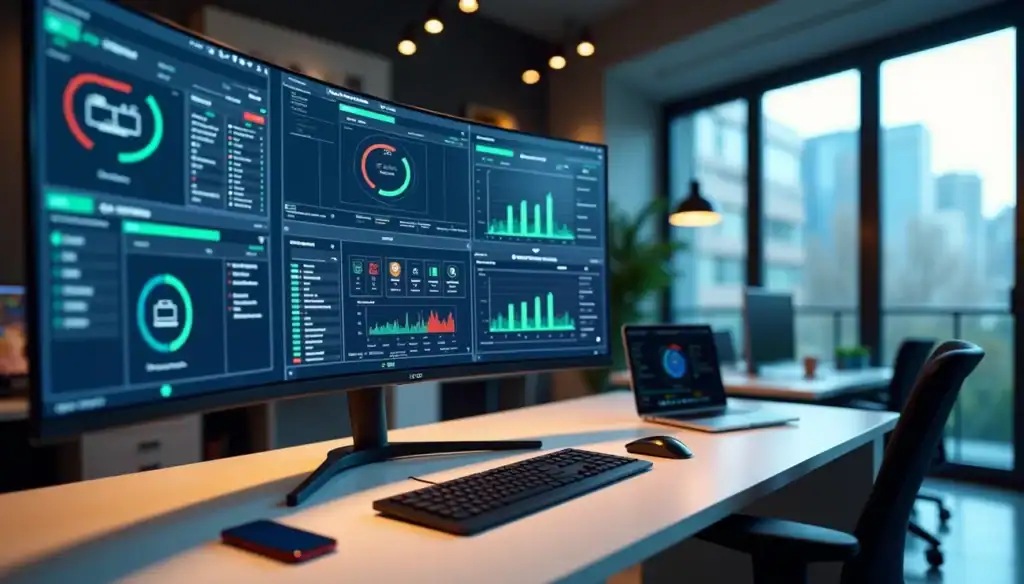
RMM gives you one dashboard to see everything. You can push out updates, troubleshoot issues, and keep security tight across all locations. Instead of constantly putting out fires, you can actually work on projects that move the business forward.
Here's a scary statistic: 43% of cyberattacks target small businesses, and the average data breach costs $120,000. When you're running a smaller operation with limited IT staff (or maybe you ARE the IT staff), RMM becomes your secret weapon.
Think of it as having a full IT team working around the clock, except it's automated software that never takes sick days or goes on vacation. One person can manage what used to require an entire team.

Modern RMM platforms offer a robust set of capabilities that form the backbone of effective IT management.
Real-Time Monitoring and Alerting: The ability to provide instant visibility into system health, with customizable alerts for performance metrics and security events.
Automated Patch Management: RMM tools automate the process of identifying, obtaining, and installing patches for operating systems and third-party applications, which is critical for security.
Remote Maintenance and Remediation: Technicians can deploy software, manage updates, and run scripts without disrupting end users, which is essential for distributed teams.
Third-Party Security & Backup Integration: Robust RMM platforms integrate seamlessly with security and backup solutions, enhancing customer security with features like advanced threat control.
Advanced Reporting and Analytics: Comprehensive reporting provides valuable insights into system health, uptime, and patch success rates, helping teams optimize resource distribution.
ITSM and PSA Tool Integrations: The connection between RMM and Professional Services Automation (PSA) tools enables automated ticket creation and streamlined workflows for powerful efficiency gains.
Multi-Tenancy and Scalability for MSPs: Multi-tenancy architecture allows MSPs to serve multiple clients from a single platform, enabling them to expand services without proportionally increasing costs or resource utilization.
Everything in One Place: Instead of jumping between different tools and dashboards, you get a single view of your entire IT environment. It's like having mission control for your technology.
Catching Problems Early: The difference between fixing a slow disk and recovering from a complete system failure is often just a matter of timing. RMM helps you fix things while they're still easy to fix.
Security That Works While You Sleep: With automated patching and constant monitoring, your security doesn't depend on you remembering to check everything manually.
More Bang for Your Buck: When you can prevent downtime and reduce the need for on-site visits, the cost savings add up quickly. Plus, your team can focus on projects that actually grow the business.
Growing Without Growing Pains: As your organization expands, RMM tools let you manage more devices and users without proportionally expanding your IT team.
Healthcare organizations can't afford to have their systems go down, lives literally depend on it. Plus, with healthcare data breaches averaging $7.42 million in costs, security isn't optional. RMM tools help hospitals and clinics maintain HIPAA compliance while ensuring critical systems stay online.
Schools and universities have unique challenges, thousands of devices used by students who aren't exactly gentle with technology. RMM helps education IT teams automate routine maintenance and push updates during off-hours. Some schools report saving 20 hours per month just on routine patching tasks.
Banks and financial institutions are prime targets for cybercriminals. With 20% of data breaches coming from unpatched vulnerabilities (according to Verizon's 2025 Data Breach Report), automated patch management isn't just convenient, it's essential for survival.
Government agencies have strict requirements for asset management and security. RMM tools help them maintain real-time visibility into all endpoints while meeting compliance requirements and managing costs effectively.
Small businesses often have big ambitions but small IT budgets. RMM levels the playing field by providing enterprise-grade capabilities without requiring enterprise-sized teams.
The world of IT management has changed dramatically, and there's no going back to the old days of reactive "break-fix" support. Organizations that embrace proactive management through RMM tools consistently outperform those that don't.
The numbers don't lie, with downtime costs that can exceed $23,000 per minute and cyberattacks becoming more sophisticated every day, the question isn't whether you can afford to implement RMM tools. It's whether you can afford not to.
The seven core capabilities we've discussed aren't just nice-to-have features, they're the foundation of modern IT management. From real-time monitoring to scalable multi-tenancy, these tools provide the visibility, control and automation you need to thrive in today's complex technology landscape.
Whether you're managing a small business, leading an internal support team, or running a managed service provider, RMM offers a path forward that's both practical and powerful. The $1.1 billion RMM market reflects a simple truth: organizations worldwide have discovered that proactive IT management isn't just better than reactive support, it's essential for success.
RMM enables proactive IT management by helping teams identify and resolve issues before they impact users, reducing downtime costs that can exceed $23,000 per minute for large enterprises.
Automated patch management is crucial for security and efficiency, addressing the fact that 20% of breaches originate from unpatched vulnerabilities.
RMM’s multi-industry applications prove its versatility: healthcare maintains HIPAA compliance, education saves valuable staff time, and SMBs gain enterprise-grade capabilities with limited staff.
Three key user groups benefit differently: MSPs manage multiple clients efficiently, internal IT teams control hybrid workforces, and SMBs achieve cost-effective automation with limited resources.
Seven core capabilities, real-time monitoring, automated patching, remote maintenance, security integrations, analytics, ITSM connections, and scalable multi-tenancy—create comprehensive IT control.
The global RMM market's value of $1.1 billion in 2025 reflects its critical importance as organizations embrace distributed work models and face evolving security challenges.