
NinjaOne has earned its reputation as a cloud-native RMM platform with an intuitive interface and solid endpoint management capabilities. However, its per-device pricing model and limited built-in PSA functionality drive many MSPs and IT teams to explore alternatives that better align with their budget structure, feature requirements or enterprise-scale needs.
The short answer: The best NinjaOne alternatives include Atera (all-in-one per-technician pricing), ConnectWise Automate (deep scripting and enterprise features), Datto RMM (MSP-focused with superior backup integration), Kaseya VSA (unified RMM/PSA platform), Zecurit (Affordable endpoint management software for SMB), Syncro (transparent pricing for small MSPs) and ManageEngine Endpoint Central (enterprise UEM capabilities). Your ideal choice depends on whether you prioritize transparent pricing, built-in PSA, advanced automation or enterprise-grade compliance features.
Before evaluating alternatives, it's essential to understand NinjaOne's pricing structure as your comparison benchmark.
NinjaOne Pricing Characteristics:
For a growing MSP managing 500+ endpoints, this per-device model can become expensive compared to per-technician alternatives. The lack of transparent pricing also makes accurate budgeting challenging during the comparison phase.
Atera stands out as the most transparent alternative to NinjaOne, offering unlimited device management under a per-technician subscription model. This platform combines RMM, PSA, and remote access in a single package, making it ideal for small to mid-sized MSPs who need predictable costs regardless of client growth.
Best for: Start-up MSPs with aggressive growth plans, IT teams managing 200-1,000 endpoints and businesses seeking transparent, all-inclusive pricing.
Trade-offs: Atera's scripting library is less extensive than NinjaOne's and some users report the patch management workflow requires more manual oversight for complex environments.
Atera: $149/technician/month (Professional) to $199/tech/month (Expert) for unlimited devices
NinjaOne: Estimated $2-4/device/month depending on volume
TCO Impact: For an MSP with 3 technicians managing 800 endpoints, Atera costs approximately $447/month ($149 × 3), while NinjaOne would cost $1,600-3,200/month. Atera delivers 65-85% cost savings at this scale.
Formerly LabTech, ConnectWise Automate is the most feature-rich RMM platform for technicians who demand deep customization and enterprise-level automation. Its proprietary scripting engine and extensive integration ecosystem make it the go-to choice for established MSPs managing complex, multi-site deployments.
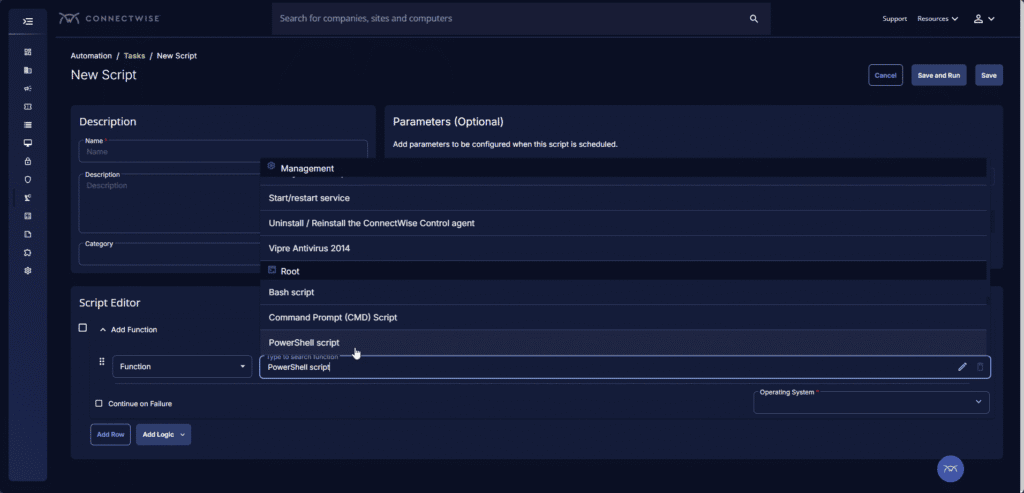
Best for: Enterprise MSPs, technicians requiring advanced scripting (beyond PowerShell/Bash) and organizations already invested in the ConnectWise ecosystem (Manage PSA, Control, etc.).
Trade-offs: Steeper learning curve, more complex initial configuration and higher implementation costs. The interface feels dated compared to NinjaOne's modern UI.
ConnectWise Automate: Per-device pricing similar to NinjaOne, but bundled savings when combined with ConnectWise Manage PSA
NinjaOne: Per-device only
TCO Impact: ConnectWise Automate's pricing is competitive at the device level, but the unified RMM/PSA bundle with Manage can reduce total software stack costs by 20-30% for MSPs needing both solutions.
Datto RMM (powered by Autotask) is purpose-built for MSPs who prioritize business continuity and backup integration. Acquired by Kaseya in 2022, Datto maintains its reputation for seamless backup and disaster recovery workflows.
Best for: MSPs offering BCDR services, Autotask PSA users and IT teams managing clients with strict compliance requirements (HIPAA, SOC 2).
Trade-offs: Less intuitive UI than NinjaOne and non-Datto backup solutions require more manual configuration.
Datto RMM: Per-device model with tiered pricing based on managed device count
NinjaOne: Similar per-device structure
TCO Impact: Pricing is comparable, but Datto's bundled BCDR + RMM packages offer better value for MSPs selling backup services, potentially reducing combined software costs by 15-25%.
Kaseya VSA is one of the few true unified platforms offering RMM, PSA and IT documentation in a single ecosystem. Its modular approach allows MSPs to scale from basic remote monitoring to full IT business management.
Best for: MSPs seeking a single-vendor solution, organizations requiring IT documentation (Kaseya IT Glue integration), and teams managing 1,000+ endpoints.
Trade-offs: Kaseya's interface complexity and configuration overhead exceed NinjaOne's plug-and-play approach. Recent security incidents (2021 supply chain attack) raised concerns about vendor security practices.
Kaseya VSA: Per-device pricing with discounts for bundled modules (RMM + PSA + IT Glue)
NinjaOne: Per-device for RMM only; PSA requires third-party integration
TCO Impact: For MSPs needing RMM, PSA and documentation, Kaseya's all-in-one pricing can be 30-40% more cost-effective than purchasing NinjaOne plus separate PSA and documentation tools.
Syncro differentiates itself through radical pricing transparency and a focus on small MSP needs. It offers RMM, PSA and remote access in an affordable, easy-to-use package.
Best for: Solo IT consultants, micro-MSPs (1-5 technicians) and businesses transitioning from break-fix to managed services.
Trade-offs: Limited enterprise features, basic reporting compared to NinjaOne and fewer third-party integrations.
Syncro: Tiered per-device pricing ($129/month for 100 devices = $1.29/device)
NinjaOne: Custom per-device quotes
TCO Impact: For small deployments (under 200 devices), Syncro's transparent pricing and all-in-one approach (RMM + PSA + remote access) delivers 40-50% cost savings versus NinjaOne plus a separate PSA.
ManageEngine Endpoint Central (formerly Desktop Central) takes a Unified Endpoint Management (UEM) approach, managing desktops, laptops, servers, mobile devices and IoT endpoints from a single console.
Best for: Enterprise IT teams, organizations with BYOD policies, multi-OS environments (Windows, Mac, Linux, Android, iOS) and businesses requiring on-premises deployment.
Trade-offs: Not MSP-focused (single-tenant architecture), lacks native PSA and requires more IT expertise for initial deployment.
ManageEngine Endpoint Central: Per-device pricing with perpetual license option
NinjaOne: Per-device subscription only
TCO Impact: For enterprises with stable device counts, ManageEngine's perpetual licensing can reduce 5-year TCO by 50-60% compared to NinjaOne's subscription-only model.
Note: ManageEngine recently launched MSP Central, a dedicated MSP platform. This section evaluates Endpoint Central, we'll assess MSP Central in a future comparison.
Zecurit Endpoint Manager is a modern, cloud-based endpoint management platform built around a straightforward philosophy: deliver enterprise-grade capabilities without enterprise-level complexity or cost. Designed for IT teams, MSPs and security teams, it combines endpoint management, IT asset management, patch management, remote access, automation and compliance reporting in a single platform under one lightweight agent. Its transparent tiered pricing and 5-minute setup make it a compelling option for teams that are tired of paying for bloated tools they only partially use.
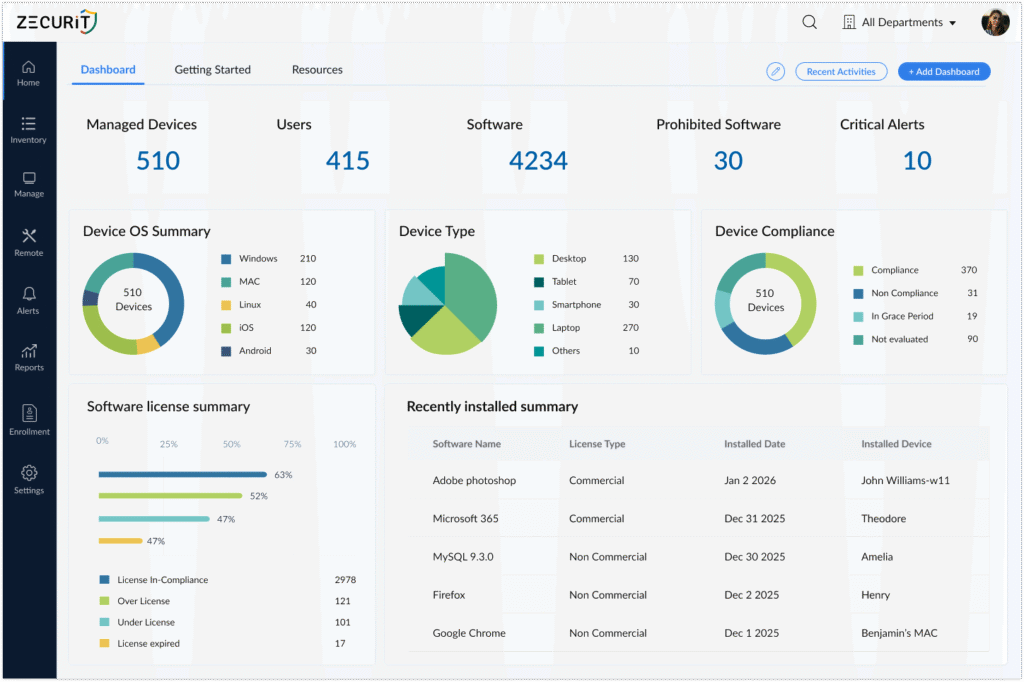
Best for: IT teams and MSPs managing 25–2,000 endpoints who need a cost-effective, all-in-one alternative to NinjaOne without the per-device pricing overhead. Also well-suited for organizations with strong compliance requirements (HIPAA, ISO 27001, PCI-DSS) seeking audit-ready reporting out of the box.
Transparent published pricing: Unlike NinjaOne's custom quote model, Zecurit offers a Free tier (up to 25 endpoints), a Standard plan at $41/month and a Professional plan at $62/month, all billed annually with no hidden fees. This makes budgeting straightforward, especially for smaller teams.
Native IT Asset Management: Zecurit includes full ITAM capabilities including hardware and software inventory, software license management, software metering, geo-location tracking and warranty management, all built into the same platform. This eliminates the need for a separate asset management tool that NinjaOne users typically require.
Built-in BitLocker Management: Zecurit provides centralized BitLocker drive encryption enforcement with TPM policy management, automated recovery key backups, flexible configuration profiles and audit-ready compliance reports. This is a capability that requires add-ons or third-party tools in NinjaOne.
Compliance-first reporting: Over 100 built-in report templates are pre-mapped to HIPAA, ISO 27001, PCI-DSS, GDPR, CIS and NIST controls, with scheduled automated delivery in PDF, CSV or XLS format. NinjaOne's reporting, while solid, requires more manual configuration to achieve equivalent compliance coverage.
Multi-platform scripting: Zecurit supports PowerShell, Bash, Python, VBScript and batch scripts across Windows, macOS and Linux endpoints, with a centralized script repository, runtime parameter control and 100+ ready-to-use templates.
Power Management: A dedicated power management module enables automated endpoint power cycles, granular AC/battery power policies, Wake-on-LAN scheduling and uptime reporting. This is a feature NinjaOne does not natively offer at this depth.
Zecurit is a newer platform and its third-party integration ecosystem is narrower than NinjaOne's. It also lacks native PSA functionality (ticketing, billing, contract management), so MSPs needing a full RMM/PSA stack will still require a separate PSA tool. The script library, while growing with 100+ templates, is smaller than NinjaOne's more established community-driven repository.
Zecurit's Standard plan starts at $41/month and the Professional plan at $62/month, billed annually, with a permanent free tier covering up to 25 endpoints.
TCO Impact: For a small IT team managing 200 endpoints, Zecurit's Professional plan at $62/month delivers the core RMM, ITAM, patch management, remote access and compliance reporting that NinjaOne users typically assemble across multiple tools and modules. The cost advantage is significant, particularly when factoring in the asset management and BitLocker tools that would otherwise require separate licensing.
| Platform | Pricing Model | Best For | Key Differentiator vs. NinjaOne |
|---|---|---|---|
| Atera | Per-technician ($149-199/tech) | Growing MSPs, predictable costs | Unlimited devices + built-in PSA |
| ConnectWise Automate | Per-device (bundled savings) | Enterprise scripting needs | Advanced automation engine |
| Datto RMM | Per-device (tiered) | MSPs offering BCDR | Native backup integration |
| Kaseya VSA | Per-device (modular bundles) | Single-vendor solution seekers | Unified RMM + PSA + documentation |
| Syncro | Per-device (transparent tiers) | Micro-MSPs, solo consultants | Radical pricing transparency |
| ManageEngine Endpoint Central | Per-device (perpetual option) | Enterprise IT, multi-OS/UEM | True unified endpoint management |
| Zecurit Endpoint Manager | Flat monthly tiers ($41–$62/mo) | IT teams & MSPs needing ITAM + RMM | ITAM, BitLocker mgmt & 100+ compliance reports |
A critical consideration when evaluating NinjaOne alternatives is the vendor's go-to-market strategy and how it impacts MSP partnerships.
NinjaOne's Direct Approach: NinjaOne primarily sells directly to MSPs and IT teams, offering standardized support and pricing through its internal sales team. This model provides consistency but limits co-marketing opportunities and channel-specific incentives.
Datto and ConnectWise Partner-First Models: In contrast, Datto RMM and ConnectWise Automate operate through channel partner programs with dedicated MSP account managers, co-branded marketing materials and revenue-sharing opportunities through their respective marketplaces (ComStore and ConnectWise Perch). According to a G2 Grid Report (Winter 2024), MSPs using channel-focused vendors report 23% higher satisfaction with vendor support and access to sales enablement resources.
Impact for MSPs: If your business model depends on vendor co-marketing support, event sponsorships or collaborative sales motions, Datto and ConnectWise offer superior partnership frameworks. If you prefer simplified, direct relationships with predictable support, NinjaOne's approach and alternatives like Atera and Zecurit may be preferable.
Choosing the right NinjaOne alternative depends on your specific priorities:
| Best For | Recommended Solution(s) | Why |
|---|---|---|
| Start-Up MSPs (Under 500 Endpoints) | Syncro or Atera | Transparent pricing, all-in-one RMM/PSA, fastest onboarding and per-technician models that scale affordably. |
| Advanced Scripting & Automation | ConnectWise Automate | Proprietary scripting engine, deepest Windows integration and most extensive automation capabilities. |
| Enterprise & Compliance | ManageEngine Endpoint Central or Kaseya VSA | UEM capabilities, robust compliance templates, and flexible deployment options (on-premises/cloud). |
| BCDR-Focused MSPs | Datto RMM | Seamless backup integration, Autotask PSA compatibility and channel-first partner programs. |
| Linux Environments | ManageEngine Endpoint Central | Superior Linux support with native package management and SSH-based remote control. |
| Predictable Costs at Scale | Atera | Per-technician pricing eliminates the per-device cost explosion as your MSP grows. |
| Cost-Effective Endpoint Management + RMM | Zecurit Endpoint Manager | Transparent flat pricing with important endpoint management features like asset, patch remote access, security control and compliance reporting built in, no add-ons required. |
NinjaOne delivers a solid cloud-native RMM experience, but its per-device pricing model and limited PSA capabilities create opportunities for alternatives to serve specific MSP needs more effectively. Whether you prioritize transparent per-technician pricing (Atera), advanced scripting (ConnectWise Automate), unified RMM/PSA (Kaseya VSA), enterprise UEM (ManageEngine) or an affordable all-in-one platform Zecurit (Zecurit Endpoint Manager), the market offers robust alternatives that may better align with your technical requirements and budget constraints.
The key is identifying your highest-priority criteria, whether that is cost predictability, automation depth, compliance needs, asset visibility or partnership support, and selecting the platform that excels in those areas. Most vendors offer free trials or proof-of-concept deployments, allowing you to validate the migration before committing.